Charting Encryption Key Management Cycles Across Acquiring Banks to Refine Verification Accuracy in Multi-Channel Transaction Streams
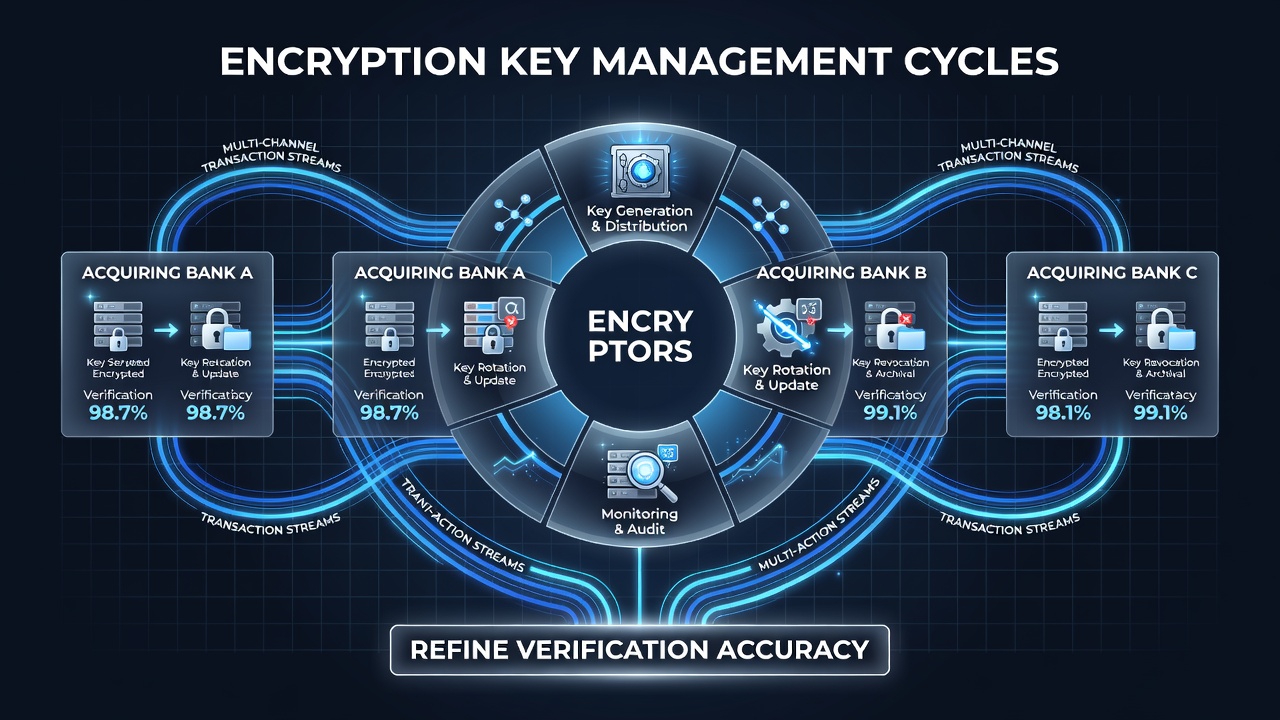
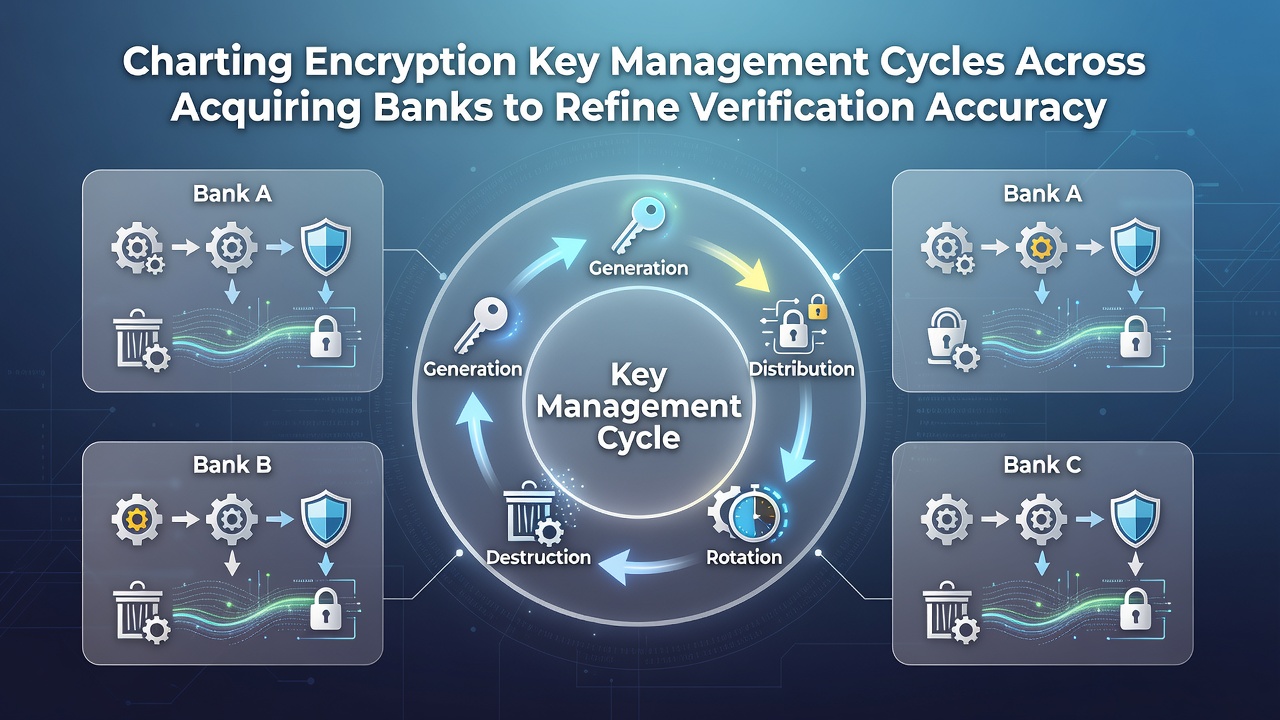
Acquiring banks track encryption key management cycles as structured sequences that include generation, distribution, rotation, and retirement of cryptographic keys used to protect transaction data. These cycles operate on defined intervals, often aligned with standards from the National Institute of Standards and Technology, and they support verification processes in both point-of-sale terminals and online payment gateways.
Key Lifecycle Stages in Acquiring Environments
Generation begins with hardware security modules that create keys compliant with AES-256 or RSA-2048 specifications, after which distribution occurs through secure channels such as TLS-protected sessions between the acquiring bank and merchant processors. Rotation schedules typically follow 12- to 24-month periods, although some institutions shorten these windows during high-volume periods like holiday sales seasons, and retirement protocols require secure wiping of decommissioned keys to prevent residual exposure in multi-channel streams.
Data from October 2026 shows acquiring banks processing over 40 billion multi-channel transactions monthly, with key rotation events logged at an average frequency of once every 18 months across major North American and European networks. Observers note that automated key management systems now integrate directly with fraud scoring engines, allowing real-time updates to verification algorithms when a key reaches its rotation threshold.
Impact on Verification Accuracy Across Channels
Verification accuracy improves when encryption keys remain synchronized across physical terminals, mobile wallets, and e-commerce platforms because mismatched keys can trigger false declines or delayed settlements. Acquiring banks employ centralized key repositories that push updates simultaneously to connected endpoints, reducing latency between authorization requests and cryptographic validation steps.
Researchers at institutions such as the European Banking Authority have documented cases where staggered key rotations in legacy systems led to temporary verification drops of up to 2.3 percent during peak transaction windows. In response, many banks have adopted orchestration tools that coordinate key changes across card-present and card-not-present channels within the same settlement batch.
Integration with Multi-Channel Transaction Streams
Multi-channel streams combine data from in-store readers, recurring billing platforms, and API-driven digital wallets, each requiring consistent cryptographic protection. Acquiring banks map key identifiers to transaction metadata so that verification engines can confirm both the key's validity and the transaction's integrity in a single lookup operation.
One study from the Reserve Bank of Australia highlighted how unified key management reduced reconciliation errors between point-of-sale batches and online authorization logs by 17 percent over a 12-month observation period. These improvements stem from timestamp alignment that links each key rotation event to specific transaction cohorts across channels.
Operational Challenges and Technical Responses
Legacy terminal fleets sometimes lag behind key rotation deadlines because firmware updates require physical intervention at merchant locations, yet modern middleware layers now relay new keys over encrypted push notifications that complete within minutes. Banks monitor compliance through dashboard metrics that flag any endpoint still operating on an expired key.
According to reports issued by the Bank of Canada, institutions that implemented automated key escrow services cut manual intervention requirements by 64 percent while maintaining PCI DSS alignment. Such systems store backup keys in geographically distributed vaults, allowing rapid recovery if a primary key becomes compromised during a rotation cycle.
Future Developments in Key Synchronization
Emerging protocols emphasize quantum-resistant algorithms for key generation, with several acquiring banks conducting pilot programs that test hybrid classical and post-quantum schemes across their transaction networks. These trials focus on maintaining backward compatibility with existing verification modules used in both physical and digital payment flows.
Figures released in late 2026 indicate that banks adopting continuous key monitoring reduced verification latency by an average of 48 milliseconds per transaction when compared with batch-based rotation methods. The gains appear most pronounced in high-frequency subscription billing environments where repeated authorizations rely on stable cryptographic sessions.
Conclusion
Encryption key management cycles at acquiring banks continue to evolve in direct response to the demands of multi-channel transaction verification. Coordinated rotation schedules, automated distribution mechanisms, and cross-channel synchronization tools together support higher accuracy rates while satisfying regulatory requirements from multiple jurisdictions. As transaction volumes grow and new cryptographic standards emerge, these cycles remain central to maintaining secure and reliable payment ecosystems.